Short Answer: How Long Does It Take to Sand Floors?
Most homes can expect sanding time of a few hours per room, but the full floor sanding and refinishing job usually takes 2 to 5 days once you include preparation, drying time between coats, and cure time.
Typical sanding times (sanding only):
- Small room (100 to 150 sq ft): 2 to 4 hours
- Average-sized room: 4 to 7 hours
- Large space (1,000+ sq ft): up to a full day
- Entire home refinishing: 2 to 5 days including finishing
Key takeaways
- Floor sanding often takes around 4 to 7 hours per room for professionals, assuming a straightforward layout.
- A complete refinishing project usually lasts 2 to 5 days once finishing and drying time are included.
- Professionals commonly sand about 15 to 20 m² per day, depending on floor condition and layout.
- DIY projects often take longer because rental sander control, dust management, and edge work slow the process.
- Floor condition, wood type, and finish choice can add extra hours, or extra days, especially when curing is needed.

Typical timeline for sanding hardwood floors
If you have never watched the process of sanding, it is easy to assume it is one quick run with a floor sander. But floor sanding is really a sequence, and each stage affects the next. Therefore, rushing early steps often creates more sanding passes later.
Preparation (around 2 to 3 hours)
This is where time can be won or lost. Furniture needs to come out, carpets and gripper rods may need lifting, and any obvious issues like loose boards, proud nail heads, or old carpet glue should be identified. In older homes, even a small sitting room can hide uneven floors or old finish buildup that adds time.
Coarse sanding (around 1 to 2 hours in an average room)
This is the heavy cut. The abrasive grit is doing the work of stripping old finish and flattening the surface. If the floorboard surface is uneven, or there are deep scratches, this stage can take longer, because you cannot skip straight to a finer grit and hope it disappears.
Medium sanding (around 1 to 2 hours)
This stage refines the scratch pattern from the coarse pass. It is also where good operators start to “read” the wood type. Softer timbers like pine floors can mark more easily, but hard timber like maple can take longer to sand cleanly.
Fine sanding and buffing (around 1 to 2 hours)
This is where floors look and feel right underfoot. It is also where edges and corners matter. The main machine covers the field, but the edge work and careful blending is what stops a floor looking patchy once varnish goes down. Many guides describe the sanding process as moving from coarse, to medium, to fine grit stages, because that progression is what creates an even finish.
Finishing (often 1 to 3 hours per coat, plus drying time)
Finishing is usually the reason the whole job is more than “one afternoon”. You may have 2 – 3 coats of varnish or hardwax, with drying time between them, plus light de-nibbing or buffing between coats for best results. Refinishing guides often outline this as preparation, sanding in stages, cleaning, then finishing with multiple coats and drying time.
In real homes, that is why a typical refinishing project is often quoted at 2 to 5 days overall, depending on access, condition, and the floor finishes used.
Sanding time by room size
Room size matters, but it is not the only factor. A large, open rectangle can actually be quicker per square foot than a smaller room packed with edges, radiators, alcoves, and doorways.
| Under 100 sq ft | 2 to 4 hours |
| 100 to 500 sq ft | 8 to 16 hours |
| 500+ sq ft | 24+ hours |
If you are sanding one room at a time, the layout often decides the pace. Larger rooms can allow smoother machine movement, but more complex layouts can slow the sanding time because edge blending becomes more detailed.
6 factors that affect how long floor sanding takes
- Floor size
More square footage means more sanding passes, more grit changes, and more time vacuuming dust between stages. - Floor condition
If the wooden floor is uneven, has multiple layers of finish, or has deep scratches, you will likely need to sand longer. Some professionals flag condition as a major timeline driver. - Type of wood
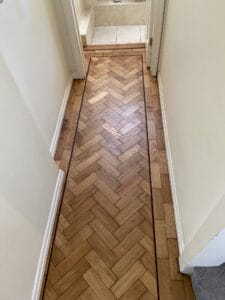
Some hardwood floors are tougher to sand cleanly, and they show mistakes more clearly. Parquet can also take longer because grain direction changes. - Experience level
DIYers often take longer because technique mistakes create more work later. - Equipment used
Professional sanding machines cut more consistently and handle dust better than many hire options. - Room layout
Corners, stairs, fireplaces, and tight edges are what stretch the timeline.
Professional vs DIY floor sanding: time comparison
Professionals tend to sand a floor faster because they work as a system and use industrial kit. As a rough output guide, some professional advice suggests 15 to 20 square metres per day depending on condition and layout.
| Professional sanding | 4 to 7 hours per room (example timelines: Floor Sanding Kent) |
| DIY sanding | 1 to 2 days per room (practical notes: Mr Sander) |
If you are weighing up the decision, our floor care advice and guides can help you compare like for like, without feeling pushed.
Expert tips to reduce floor sanding time
If your priority is a job done quickly, the fastest route is not rushing the sanding, it is removing the friction that causes repeated work.
Clear the room fully, repair loose boards and nail heads, then follow a sensible grit sequence from coarse to fine. Most swirl marks come from skipping a grit, or moving too fast. A staged approach is a common theme in good sanding guidance.
Situations that can extend sanding time
Deep scratches and uneven floors often mean additional sanding passes. Old adhesive, especially carpet glue, can clog abrasives. Multiple layers of finish take longer to strip. Humidity can also affect drying time, which is why finishing can stall even when the sanding is done.
So, how long should you set aside?
Most floors only take a few hours to sand, but floors refinished properly usually take several days once you include prep, finishing, drying time, and cure time. The timeline depends on room size, floor condition, the type of wood, and whether you are hiring a professional or going DIY.
If you are still unsure, feel free to ask. We will give you a calm answer, no pressure. If you are ready to explore it properly, start here: wood floor sanding and restoration.